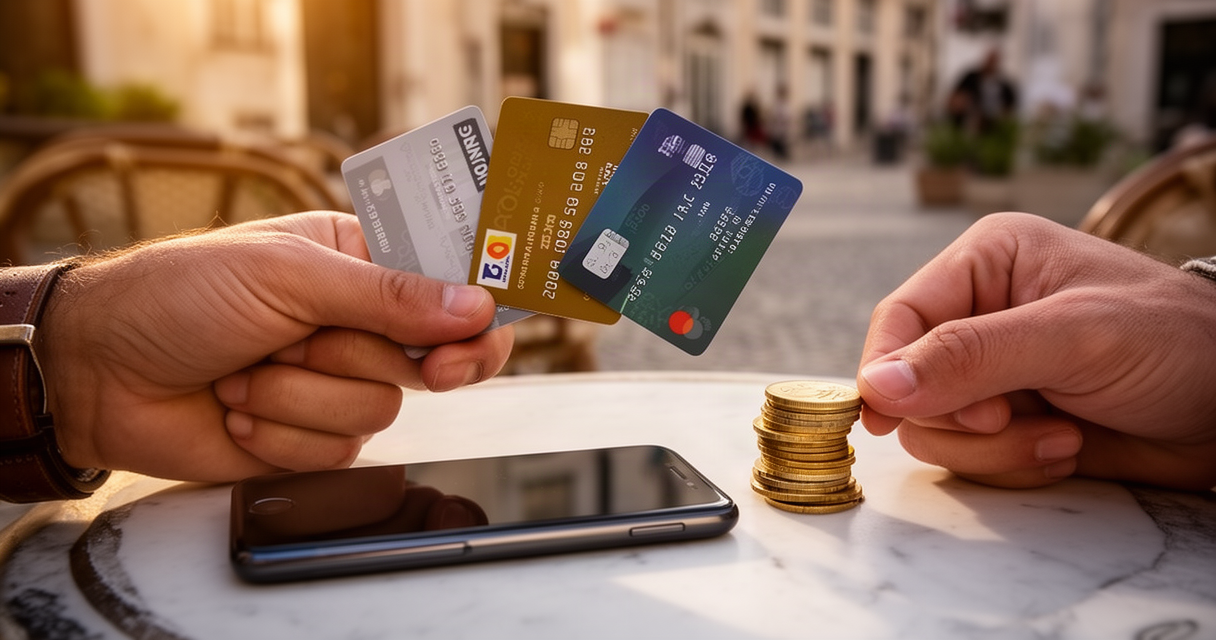
A card declines at a restaurant table in Stockholm, the app says “suspicious activity,” and the friends who were just invited out are watching. That scenario, reported by a traveler on r/digitalnomad, explains why the question is not simply which travel card has the lowest fee.
The short answer: a no-fee debit card from a traditional bank (a Schwab-style account for US residents) is the best default for ATM cash and everyday spending, Wise is the best tool for holding foreign currency and paying rent or bills abroad, and Revolut is the better weekday card in Europe. Almost no one on the threads recommends only one of them. The cheapest setup is a pair, chosen by trip type.
The sections below cover the real fee structures, the freeze risk that decides who should hold what, and a pick-by-situation guide for the three setups.
Wise, Revolut, or Schwab: What Each One Is Actually For
The three are often compared as if they were the same product. They are not.
Wise is built around currency conversion at the mid-market rate with a disclosed fee, plus multi-currency balances and local bank details. Wise’s own UK card page states “Spend at the mid-market rate” and “No charges just for using your card abroad, with low conversion fees.” Its strength is moving and holding money across currencies.
Revolut is a full app-based banking product with budgeting tools, virtual cards, and tiered plans. Its draw is the card experience in Europe. Its cost structure changes by plan and by country, which makes a single headline number unreliable.
Schwab-style checking is the traditional-bank option, popular with US travelers because of unlimited ATM fee reimbursement and no foreign transaction fees. It does little else: no multi-currency balances, no local account details abroad.
On r/digitalnomad, the most-upvoted answer in a thread about international payment fees skipped the fintechs entirely:
“No-foreign-transaction-fee credit card and Schwab checking account with ATM reimbursement is everything I have ever needed.”
The qualifier that follows in the same comment matters: countries with a parallel cash-dollar market are an exception, where bringing USD cash can beat any card.
The Fee Comparison (Checked October 2026)
Fee pages for these products vary by country, and several of them could not be retrieved in full for this article, so the table separates what was verified from what was not.
| Wise | Revolut (Standard) | Schwab-style checking | |
|---|---|---|---|
| Card conversion | Mid-market rate plus a low disclosed fee (per Wise’s UK page) | Reported as mid-market on weekdays within plan limits; weekend markup reported | No foreign transaction fee reported |
| Free ATM allowance | UK page: free up to 250 GBP per month, then 2.69% on the excess | Plan- and country-dependent; allowance reported in the low hundreds of euros | Unlimited fee rebates reported, credited after the fact |
| Weekend markup | None stated | Reported at 1% on Standard | Not applicable |
| Holds multiple currencies | Yes | Yes | No |
| Verified on an official page | Partly (UK page only) | No, official page blocked | No, official page blocked |
Two caveats apply. Wise’s 250 GBP figure comes from its UK page; a commenter on r/digitalnomad claimed the free ATM amount was cut to $100 from $350 in April 2026 for Singapore, which could not be confirmed on an official page. The Revolut and Schwab numbers come from third-party summaries and search snippets and should be checked in-app or on the provider’s own page before a trip.
The Revolut weekend markup is the one number that appears repeatedly in traveler experience. One long-time user on r/digitalnomad wrote:
“As a multi currency card Revolut has been slightly cheaper for me Monday to Friday than Wise but Revolut apply a 1% fee at the weekend.”
Travelers who swap cards depending on the day are optimizing a fraction of a percent. The bigger losses sit elsewhere.
The Mistake That Costs More Than Any Fee
Declining the terminal’s offer to convert into the home currency saves more than any card choice. This is dynamic currency conversion, and a traveler in Brazil described the cost on r/digitalnomad:
“In Brasil the terminals and ATMs sometimes ask you if you want to exchange to reais from dollars or if you want to pay in the local currency. You might think you don’t have a choice but you do. […] Exchanging will cost you a percentage of 11 -14% more typically.”
That 11 to 14% figure is one user’s experience, not a measured average, but the direction is consistent with the standard guidance: always pay in the local currency and let the card issuer do the conversion. A 0.5% difference between Wise and Revolut is small next to a single wrong tap at an ATM.
ATM operator fees are the second leak. Neither Wise nor Revolut controls what a local bank charges, which is the main reason a card with ATM fee reimbursement keeps its place in the stack.
The Freeze Risk Decides Who Holds What
Fees are visible. Freezes are not, and they set the structure of a sensible setup.
A thread on r/digitalnomad titled as a warning about fintech accounts described a Wise account closed with around $60,000 inside after the owner moved abroad. The poster wrote:
“Yes eventually they give you your money back, but after they exhaust every nerve in your brain especially if you were using wise exclusively and all your money are there, you’re screwed for a solid 60 to 90 days.”
The replies split in a useful way. Many pointed out that the original poster kept a large balance in an app that is not a deposit-taking bank in every region. Others noted that conventional banks also close accounts when a customer’s residency changes. One commenter put the cause in structural terms:
“Fintech closures rarely happen because of volume, they happen because the user doesn’t clearly belong to a single regulatory environment.”
That framing matters because it applies to the exact audience reading a travel-money comparison: long-stay travelers and remote workers whose income, tax residency, and address do not match. For a two-week holiday, the risk is a declined card. For a year abroad, the risk is a locked balance.
The Stockholm restaurant story, from the Wise versus Revolut thread, shows the short-trip version:
”[…] their debit card declined on me a couple of times when I least expected it. Example: I invited friends out to a restaurant in Sweden and when I tried to pay for it my Wise card got locked up ‘because of suspicious activity.’ That is when you need another card.”
The same thread contained the shortest summary of the whole topic from another user: “Both, you never know when either of these gEniUsEs are gonna freeze your account because they “need more information about x,y,z” so you can use the other one.”
Pick by Situation
Pick Schwab-style checking if the trip is mostly cash and cards
US travelers on trips of a few weeks to a few months, in countries with ordinary card acceptance and ATMs, are the group best served by a traditional no-fee debit card plus a no-foreign-transaction-fee credit card. The structure is boring and has the fewest failure points. The limit is eligibility: travelers outside the US need to find the local equivalent, and a Schwab-style account does not hold foreign currency or provide local bank details for rent.
Pick Wise if money has to move or sit in another currency
Wise earns its place for rent, deposits, and contractors paid in a local currency. One traveler in the payments thread described the workflow in specifics:
“I have my Schwab account linked to my WISE by ACH. I pay no fees transferring my USD from Schwab into my WISE account using ACH. I pay about $10 every $1000 to convert my USD to whatever local currency within WISE.”
That is about 1%, which matches the 0.4 to 1.5% range another poster in the same thread gave for Wise’s variable fees. The takeaway is that Wise works best as a pipe from a real bank, funded in small amounts, rather than as the bank itself.
Pick Revolut if the trip is Europe and the card is the daily driver
Revolut’s card was described as rarely declining within Europe, with a strong app and virtual cards for one-off online purchases. The weak spots from the threads are the weekend markup on lower plans, steeper ATM fees beyond the allowance, and country-specific limits: one user reported a Revolut card failing in Doha while Wise worked. For multi-region itineraries that extend outside the EU and UK, Revolut should not be the only card.
Our Take: Two Cards Beat the Right Card
The same rule that applies to travel AI tools applies to travel money apps: they are good at logistics and poor at judgment. An app that offers the “best” rate cannot know that a trip crosses a country where its network is rejected, or that a residency change will trigger a review. That knowledge comes from the traveler.
The evidence from the threads points one way. The cheapest single card is rarely the one that gets used all trip, because cards fail at the worst time. A primary card plus a backup from a different issuer costs nothing to carry and removes the largest risk.
The counter-argument is simplicity. Managing three cards, two apps, and a bank is real overhead, and for a one-week holiday it is unnecessary. A single no-foreign-transaction-fee card with a backup stored in the hotel safe is enough for a short trip.
For anyone planning a longer stay, the related residency question is covered in the guide to AI Schengen and tax residency trackers, and the insurance side of long trips is compared in Genki vs SafetyWing. For the spending plan itself, the best AI travel budget planners cover what to budget before choosing a card. Those traveling on data-only SIMs can also check Airalo vs Holafly so a payment app is not the only thing that needs a signal.
Frequently Asked Questions
Is Wise or Revolut cheaper for spending abroad?
For weekday card spending the two are close, and the gap depends on country, plan, and amount. Revolut’s Standard plan is reported to add a markup on weekend currency exchange, while Wise converts at the mid-market rate plus a disclosed fee. Compare the final amount received for a real quote before relying on either.
Can Wise or Revolut freeze an account while traveling?
Yes. Both run compliance checks, and travelers on r/digitalnomad report cards locked for suspicious activity and accounts held for weeks during identity or residency reviews. Carrying a second card from a different provider is the standard protection.
Should savings be kept in Wise or Revolut?
Most experienced travelers in the threads keep only a few weeks of spending money in either app and hold the rest at a conventional bank. Commenters stressed that Wise is not a bank in every region, and a freeze on a large balance can last weeks.
What is dynamic currency conversion and why decline it?
It is the ATM or terminal offering to charge in the traveler’s home currency instead of the local one. The terminal’s rate is usually worse than the card issuer’s, so the standard advice is to always choose the local currency.
Does a Schwab-style checking account work for non-US citizens?
Schwab’s checking product is aimed at US residents and, per Schwab’s published materials as summarized in search results, is linked to a Schwab One brokerage account. Travelers outside the US should check which banks in their home country offer ATM fee reimbursement and zero foreign transaction fees.
Is one card enough for a long trip?
Two is the practical minimum. Travelers consistently describe a primary card plus a backup from a different issuer and, ideally, different network, so a single freeze, decline, or ATM rejection does not strand the trip.
The Verdict: Carry a Pair, Hold Little in the App
For most travelers the winning setup is a no-fee bank debit card for cash, Wise or Revolut as the second card, and only a few weeks of spending money inside either app. The fee differences between the apps are small, and the freeze and decline risks are the real cost.
Before departure, check the current fee page for the country in question, set the apps to pay in local currency, and keep one card physically separate from the others.
A cheap exchange rate does not help when the card is locked and the dinner bill is on the table.
References
- Wise, UK card spending pricing page (ATM allowance, mid-market spending), checked 2026-10-21 — https://wise.com/gb/pricing/card-spending
- r/digitalnomad, “Revolut or Wise? What’s one working the best for you?” — https://reddit.com/r/digitalnomad/comments/1sb8eo9/revolut_or_wise_whats_one_working_the_best_for_you/
- r/digitalnomad, “beware of the so called ‘financial institutions’ like wise, revolut and especially mercery” — https://reddit.com/r/digitalnomad/comments/1qu3oay/beware_of_the_so_called_financial_institutions/
- r/digitalnomad, “Lets talk about international payment solutions that actually don’t destroy you with fees” — https://reddit.com/r/digitalnomad/comments/1qj2wpp/lets_talk_about_international_payment_solutions/
- Schwab Bank Investor Checking (page returned an authorization error when fetched; details taken from search-result summaries and not independently verified) — https://www.schwab.com/content/schwab-bank-investor-checking
- Revolut Standard plan fees (official page returned 403 when fetched; weekend markup and ATM allowance taken from third-party summaries and user reports) — https://www.revolut.com/legal/standard-fees/